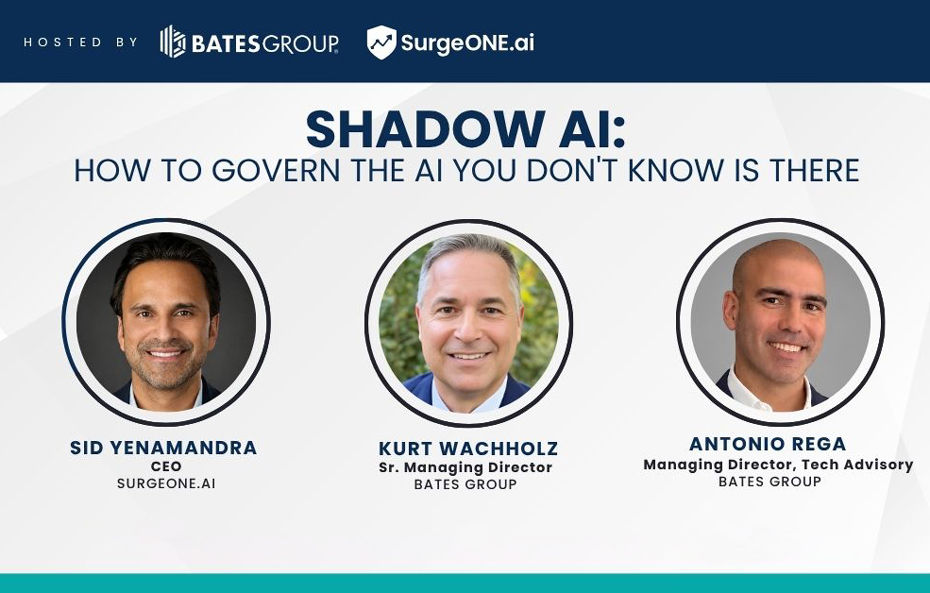
Artificial intelligence is transforming financial services, but not all AI use is visible to the firm. Employees may use public tools such as ChatGPT, Claude, Gemini, or Microsoft Copilot, while established software vendors quietly add AI features to products the organization already approved. This creates a critical question for RIAs, broker-dealers, and wealth managers: how do you govern AI you do not know is there?
Shadow AI includes tools, features, agents, or services used without appropriate visibility, approval, or oversight. It may involve an employee pasting client information into a personal AI account, a meeting assistant processing conversations, or an application gaining access to email, documents, or shared folders.
As SurgeONE CEO Sid Yanamandra observed during the webinar, organizations are moving from “bring your own device” to “bring your own app.” The risk is not simply whether employees use AI. It is what the AI can access, what it can do, and whether the firm can reconstruct its activity afterward.
When client or business information enters an AI service, firms need to know where it is processed, how long it is retained, whether it may train a model, and whether personally identifiable information (PII) or non-public information (NPI) is exposed. Approval of the underlying vendor does not automatically govern every new AI capability. Permissions, integrations, contracts, logging, and retention practices must be reassessed continuously.
1. Inventory AI-Enabled Applications
Identify employee-selected apps, corporate SaaS platforms, meeting tools, and vendor systems. Record who uses them, whether accounts are personal or enterprise-managed, what data they access, and whether security and compliance have reviewed their AI functions.
2. Map Data and Access
Connect the AI inventory to a data inventory. Determine which tools can reach email, documents, client systems, cloud environments, and third-party platforms. A Data Impact Assessment can help firms understand significant data movement and associated controls.
3. Monitor Sensitive Data
Use Data Loss Prevention controls, audit logs, and alerts to detect sensitive information moving into AI services. Test controls with dummy data to confirm that attempts to submit account details or Social Security numbers are detected or blocked.
4. Train Employees
A blanket ban can drive AI usage underground. Consider a no-fault disclosure window that asks employees which tools they use and which workflows they want AI to improve. Then move valuable use cases into approved, controlled environments.
AI-generated language can sound authoritative while still being inaccurate. Human review remains essential when content may reach clients, prospects, regulators, marketing channels, or public websites. AI can accelerate the work, but accountability should remain human.
Discover AI use. Map accessible data. Assess vendors and permissions. Control access with least privilege, DLP, logging, and approved-tool lists. Educate employees on safe use. Monitor continuously as models, agents, integrations, and vendor features evolve.
Responsible AI adoption is not about stopping innovation. It is about giving the organization enough visibility, governance, and confidence to innovate safely.
Ready to bring Shadow AI into the light?
Assess where AI is operating across your firm, understand what data it can reach, and build a governance framework for responsible adoption with SurgeONE.
Editorial note: This article is based on themes from the Shadow AI webinar presented by Bates Group and SurgeONE.ai. It is educational and does not constitute legal advice.

The regulatory record for financial services. One platform unifying compliance, cybersecurity, data, and AI governance for regulated financial firms.