Artificial intelligence is transforming how advisory firms supervise risk, review communications, and protect clients. Regulators now expect
firms to deploy AI with clear governance, expert validation, and documented accuracy. This ebook explains what SEC and FINRA are looking for, the risks firms must control, and how CCOs can integrate AI responsibly without increasing exposure.
This guide gives compliance leaders a practical, expert-level view of how to adopt artificial intelligence safely and effectively inside advisory programs. It covers the supervisory standards regulators expect, the operational risks firms must manage, and the steps CCOs can take to strengthen oversight as AI becomes part of daily operations.
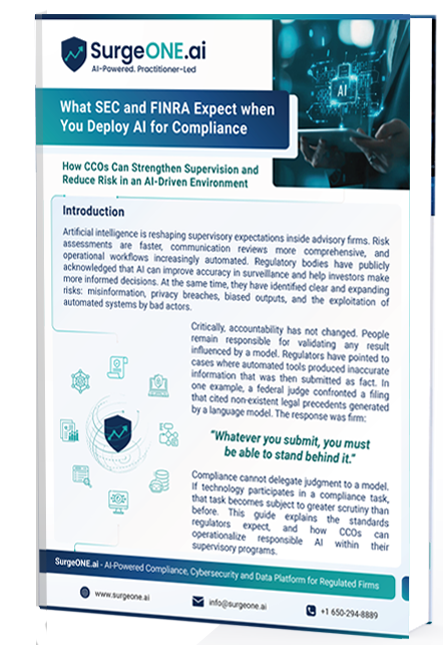
Articial intelligence is reshaping supervisory expectations inside advisory firms. Risk assessments are faster, communication reviews more comprehensive, and operational workows increasingly automated. Regulatory bodies have publicly acknowledged that AI can improve accuracy in surveillance and help investors make more informed decisions. At the same time, they have identied clear and expanding risks: misinformation, privacy breaches, biased outputs, and the exploitation of automated systems by bad actors.
Critically, accountability has not changed. People remain responsible for validating any result inuenced by a model. Regulators have pointed to cases where automated tools produced inaccurate information that was then submitted as fact. In one example, a federal judge confronted a ling that cited non-existent legal precedents generated by a language model. The response was firm:
"Whatever you submit, you must be able to stand behind it."
Compliance cannot delegate judgment to a model. If technology participates in a compliance task, that task becomes subject to greater scrutiny than before. This guide explains the standards regulators expect, and how CCOs can operationalize responsible AI within their supervisory programs.
Articial intelligence is no longer a discretionary add-on. It is now embedded in compliance infrastructure, delivering insights and operational eciencies that firms rely on. Regulators expect firms to treat AI as a core compliance function, which means establishing policies and procedures for exactly how it is used, assessed, supervised, and governed.
The foundation of regulatory guidance today centers on one principle: AI must enhance human judgment, not replace it. Tools that analyze communications, ag potential misconduct, or generate reporting cannot operate without trained professionals validating the outputs. Compliance functions that depend on accuracy must be monitored for correctness when AI participates.
Regulators specically warn against a false sense of safety. Algorithms can misinterpret context, hallucinate, or fail to consider evolving rules. Supervisory programs must therefore document the skills and authority of the individuals reviewing AI results. Junior personnel are not considered adequate control in areas requiring legal interpretation or regulatory nuance.
AI does not lower responsibility. It raises the standard of proof that decisions were properly reviewed and built on proper foundation.
Compliance Takeway
CCOs must be able to demonstrate that artificial intelligence improved their supervisory process without reducing accuracy or accountability.
Regulators are increasingly asking firms to identify every instance where AI plays a role in compliance operations, including use cases embedded inside third-party tools. A surveillance platform, CRM plugin, or risk scoring engine may incorporate AI even if the rm has not explicitly implemented AI internally. Examiners want CCOs to know which tools are using models, what data they ingest, how they generate conclusions, and what degree of human oversight is applied to outputs.
This represents a shift in vendor management. Firms must expand due diligence to consider:
Recordkeeping obligations also evolve when AI generates regulated content. For example, automated meeting notes must be retained in the same way as written communications and documentation are retained today. The risks broker/dealers and investment advisory firms face today, with the prevalence of AI note-taking tools, are very similar to what we have seen with recent enforcement actions coming out of the use of “off-channel communications”. For example, suppose an associated person or access person utilizes an AI note-taking tool without their rm’s knowledge or consent. In that case, that individual has created a situation where the rm lacks the ability to supervise the individual’s activities, thus creating potential regulatory exposure for the rm for failure to supervise and for failure to retain those records which were created in the course of the rm’s business (a violation of SEC Recordkeeping Rules).
As we have seen from SEC and FINRA enforcement actions against firms and their associated persons/access persons, these transgressions come at a very high risk to both the firms and the individuals involved, and the nes have been quite sizeable. Additional exposure may also be created on a state or civil level by the use of unauthorized AI note-taking tools, resulting in civil, administrative, and or criminal penalties.
Compliance Takeway
If compliance relies on a model, the CCO must be able to show how the model itself is supervised and how it complies with SEC Recordkeeping Rules.
The key question examiners ask now is:
What AI tools has your rm approved for use by your associated persons, how do you supervise the use (and output), and how does your rm document its supervision, and where does the rm archive the materials reviewed/approved for use?
Regulators have already initiated enforcement actions against firms making exaggerated claims about AI capabilities. The early violations have centered on messaging that overstates sophistication, implies predictive accuracy, or suggests that a model can outperform human expertise. In several cases, firms promoted themselves as rst or exclusive AI-powered advisors without proof to support those assertions.
Overclaiming technological advantage is increasingly treated as a form of misrepresentation. This is analogous to greenwashing in environmental investing: a hype driven narrative that lacks evidence.
Compliance ocers must review all marketing language to ensure:
Jeff Kern, who previously served in senior enforcement roles at FINRA and the NYSE, emphasized, “Do not be careless. Do not be misleading.”
Accuracy includes both technical and ethical precision. A single AI-generated error that reaches investors or regulators can trigger additional scrutiny across the entire program.
Compliance Takeway
Marketing of AI must be as carefully controlled as product claims in advisory services.
Smaller firms often view AI as a way to improve capacity without expanding headcount. That can be true, but only if the AI adoption process is structured and defensible. Without adequate planning and stang to review outputs, firms risk exposing themselves to more supervision failures than they resolve.
A measured implementation approach includes:
Regulators understand that smaller firms operate with limited resources. They do not expect perfection, but they do expect rms to do their due diligence and to be thoughtful in their approach to adopting any new technology.. Each decision must reect an understanding of how the system will be used, the risks associated with its use, the adoption of compliance policies to establish accountability, and controls around documentation requirements.
There is strong regulatory appreciation for innovation, but no tolerance for a lack of governance and controls to ensure compliance with industry regulations. Many small firms seek to adopt AI and other technologies because they can streamline their operations, make compliance more consistent and more accurate, and it can result in overall cost savings. However, firms are reminded that they must document their due diligence and put the compliance guardrails in place around the new technology before using it.
Compliance Takeway
Lean supervisory environments benet the most from AI, but only when implemented with thoughtful discipline.
Regulators have moved quickly from awareness to structured evaluation. They already use advanced technology to review submissions, identify anomalies, and monitor behavioral trends. Examiners may soon expect firms to maintain similar sophistication in their own internal systems.
The next phase of regulatory scrutiny will include:
In addition, firms will be asked to explain how their supervisory structure will evolve as AI capabilities improve. The bar for accountability is rising, not falling. Looking ahead, technology will accelerate examinations rather than delay them.
AI is not a temporary trend. It is a new operational foundation. Firms that build a compliance strategy around it now will be best equipped to handle both regulatory demands and industry competition.
Compliance Takeway
CCOs should assume AI is becoming essential for maintaining supervisory excellence, but they must also prepare for expanded focus on vendor due diligence and supervisory controls around its use.
Articial intelligence offers tremendous opportunity: more effective oversight, faster anomaly detection, and stronger protection for clients. But the introduction of any new system that inuences judgment requires thoughtful governance and heightened accountability.
CCOs are uniquely positioned to determine how AI strengthens the quality and defensibility of their compliance programs. The priority is not volume of automation. The priority is clarity and control. When used correctly, AI can reduce operational strain and increase supervisory consistency while enhancing regulatory relationships instead of challenging them.
The message remains consistent:
With intentional design and ongoing validation, AI becomes a compliance multiplier, not a compliance risk.

The system of record for AI-era compliance. One platform unifying compliance, cybersecurity, data, and AI governance for SEC, FINRA, and state-regulated firms.