
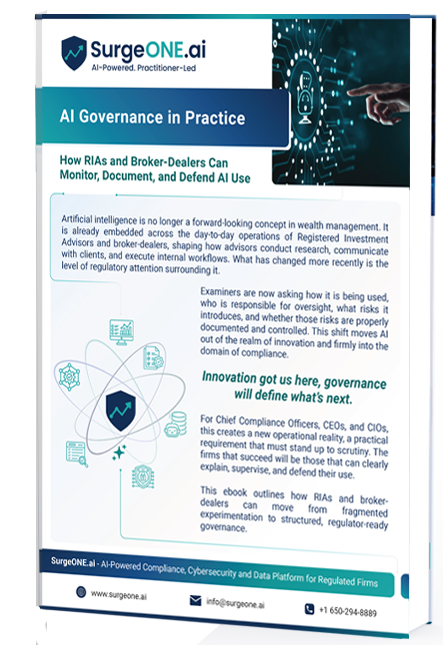
Artificial intelligence is no longer a forward-looking concept in wealth management. It is already embedded across the day-to-day operations of Registered Investment Advisors and broker-dealers, shaping how advisors conduct research, communicate with clients, and execute internal workflows. What has changed more recently is the level of regulatory attention surrounding it.
Artificial intelligence is no longer a forward-looking concept in wealth management. It is already embedded across the day-to-day operations of Registered Investment Advisors and broker-dealers, shaping how advisors conduct research, communicate with clients, and execute internal workflows. What has changed more recently is the level of regulatory attention surrounding it.
Examiners are now asking how it is being used, who is responsible for oversight, what risks it introduces, and whether those risks are properly documented and controlled. This shift moves AI out of the realm of innovation and firmly into the domain of compliance.
For Chief Compliance Officers, CEOs, and CIOs, this creates a new operational reality, a practical requirement that must stand up to scrutiny. The firms that succeed will be those that can clearly explain, supervise, and defend their use.
This ebook outlines how RIAs and broker-dealers can move from fragmented experimentation to structured, regulator-ready governance.
One of the most difficult aspects of AI governance today is that the concept itself lacks precision. Within most firms, there is no shared definition of what constitutes AI, where it exists within the technology stack, or how it should be categorized from a risk perspective.
This ambiguity creates immediate downstream issues. If a firm cannot clearly define AI, it cannot inventory it. If it cannot inventory it, it cannot supervise it. And if it cannot supervise it, it cannot credibly defend its use to regulators.
At the same time, adoption continues to accelerate. Advisors are incorporating AI tools into their workflows because those tools offer clear productivity gains. In many cases, these tools are not even perceived as “AI” by end users, because they are embedded within software already in use, such as office productivity suites, CRMs, or research platforms.
This creates a fundamental disconnect between how firms think about AI and how it is actually being used in practice. Governance frameworks often focus on well-known tools, while risk is introduced through less visible channels. For RIAs and broker-dealers, this gap represents the starting point of regulatory exposure.
AI risk is now beyond chatbot usage because it is increasingly embedded within vendor ecosystems, often several layers removed from the firm itself. A vendor may incorporate AI into its product, while relying on third-party models or infrastructure providers that introduce additional, often opaque, dependencies.
This layered architecture significantly complicates vendor due diligence. Traditional assessments focused on cybersecurity posture and data handling are no longer sufficient. Firms must now understand whether AI is present within the vendor’s offering, how it operates, and what happens to the data that flows through it.
For many compliance teams, this is a difficult transition. The technical complexity of AI systems, combined with inconsistent vendor disclosures, makes it challenging to assess risk with confidence. In practice, many vendors use broad or ambiguous language when describing their AI capabilities, which further obscures the underlying mechanics.
At the same time, the risk of data exposure has increased materially. Advisors may upload client information into tools that process and store that data in ways that are not aligned with the firm’s privacy policies. Even when firms believe they have restricted such behavior, they often lack the visibility needed to confirm compliance.
For RIAs and broker-dealers operating under fiduciary obligations, this is not a marginal issue. It strikes at the core responsibility to protect client data. The inability to trace where that data flows, or how it is used, creates a level of risk that regulators are increasingly focused on.
Most firms already have policies that address technology usage. Increasingly, they are also drafting policies specific to AI. However, the existence of a policy does not equate to effective governance.
The central issue is enforcement. A policy that cannot be monitored or verified does not reduce risk. In fact, it can increase it by creating a documented expectation that the firm cannot meet in practice.
This dynamic is not new. The industry has seen similar patterns with off-channel communications, unapproved CRM systems, and unauthorized data storage. In each case, firms established policies prohibiting certain behaviors, only to discover during examinations that those behaviors were occurring anyway.
AI introduces the same challenge, but at a larger scale. Advisors have strong incentives to use these tools, and many of them are easily accessible. If firms respond by simply prohibiting usage, they risk driving activity outside of observable channels.
For compliance leaders, the implication is clear. Governance cannot rely solely on restriction. It must be grounded in visibility. Firms need to know what tools are being used, how they are being used, and whether that usage aligns with policy. Without that visibility, enforcement becomes theoretical.
The traditional compliance response to new technology has been to limit or prohibit its use until risks are fully understood. In the context of AI, that approach is increasingly untenable.
AI is becoming a foundational component of modern workflows. Advisors who do not leverage it will face competitive disadvantages, particularly as clients begin to expect faster insights, more personalized communication, and greater operational efficiency.
As a result, leading RIAs and broker-dealers are shifting their approach. Instead of asking how to block AI, they are asking how to enable it in a controlled and defensible way.
This shift requires a different mindset. Rather than focusing on prohibition, firms must design environments where AI can be used safely. That includes selecting approved tools, implementing guardrails around data usage, and ensuring that activity can be monitored and audited.
It also requires providing viable alternatives. If advisors are told not to use certain tools but are not given compliant options, they will find workarounds. Controlled adoption succeeds when firms make it easier to comply than to circumvent controls.
From a regulatory perspective, this approach is far more defensible. It demonstrates that the firm is not ignoring AI or attempting to suppress it, but is actively managing its use in a structured way.
For RIAs and broker-dealers, effective AI governance must translate into a framework that regulators can understand and evaluate. This framework is not defined by a single policy or tool, but by the integration of several components.
It begins with clarity. Firms must define what AI means within their organization and identify where it is used. This includes both direct usage by employees and indirect usage through vendors. Without this foundational understanding, all other controls are built on incomplete information.
From there, governance must be formalized. Many firms are establishing internal structures, such as AI governance committees, to oversee policy development, risk assessment, and ongoing supervision. This reflects a broader recognition that AI is not a one-time initiative, but an evolving area that requires continuous attention.
Technology plays a critical role in enabling this framework. Firms need systems that provide visibility into usage, monitor behavior across devices and applications, and generate evidence that policies are being followed. This evidence is essential during regulatory examinations, where firms are expected to demonstrate not just intent, but execution.
Finally, governance must be aligned with the firm’s broader data strategy. AI amplifies the importance of data ownership and control. Firms that understand their data flows and maintain strong governance over them are better positioned to leverage AI while managing risk.
AI is rapidly becoming part of the operational fabric of RIAs and broker-dealers. The question is no longer whether firms will use it, but whether they can do so in a way that meets regulatory expectations.
This requires a shift from experimentation to accountability. Firms must move beyond informal usage and develop structured approaches to governance that include clear policies, enforceable controls, and verifiable oversight.
The risk is not simply that AI will be used incorrectly. The greater risk is that it will be used in ways that the firm cannot explain or defend. In a regulatory environment that increasingly emphasizes documentation, supervision, and fiduciary responsibility, that gap can have significant consequences.
Firms that approach AI thoughtfully, integrating compliance into the adoption process rather than reacting after the fact, will be best positioned to navigate this transition. They will not only reduce regulatory exposure, but also build a foundation for sustainable, responsible innovation.
In the end, AI governance is about ensuring that technology operates within the boundaries of trust, accountability, and regulatory discipline.
To learn more about how SurgeONE can help your firm operationalize AI governance, enforce policies, and stay ahead of evolving regulatory expectations, visit SurgeONE.ai or get in touch with our team.

The regulatory record for financial services. One platform unifying compliance, cybersecurity, data, and AI governance for regulated financial firms.